Open Access
Laboratory Life.
How Physiologists Discovered their Everyday
Philipp Felsch
"How could anyone ignore the details of our daily work" uttered molecular biologists from the Californian Salk Institute with astonishment, when, upon reading Bruno Latour's anthropological account of their daily work, Laboratory Life , in 1979, they were informed that Latour's approach was somewhat revolutionary within the social study of science. (Latour 1986, 274) Had scientists always known what historians and sociologists of science were only then beginning to realize: that scientific knowledge was not just a matter of theory and abstract thinking, but the product of everyday practices, shaping scientific results just as much as, and probably even more than, the theoretical, the abstract, and the erudite? Had scientists even actively dealt with their everyday, long before the scholars of the late 20th century?

|
||

|
|
|
|
||
The Crisis of the Sciences
The relationship between modern sciences and the everyday, in Western thought, has been a difficult one since Edmund Husserl's late work. With his momentous concept of the life-world, Husserl introduced extensive reflections on the character and the crisis of the modern sciences: the sciences had lost their meaning for man, he wrote, because their formal abstraction had removed them from all matters of the practical everyday, the life-world. The sciences were thus currently undergoing a deep crisis. Phenomenology itself was the attempt to overcome this crisis by reconnecting the sciences with their original meaning, i.e., by reconstructing their emergence from everyday practices: "the life of acts [Aktleben] practised by working scientists, working with one another [...] the persons, the apparatus, the room in the institute, etc." (Husserl 1970, 122ff.) Recognizably penned by Husserl, these words, which, in Husserl's own understanding, circumscribed "a vast theme for study", seem to point to the later work of Bruno Latour. (Husserl 1970, 123) Whereas Husserl himself had limited his study of the everyday in science to rather general remarks, for example on the connection of Galileo's mathematical physics to the practical art of land survey, Latour undertook lengthy fieldwork amidst molecular biologists to record and describe in detail their "life of acts", through which the scientific facts, they later published, were constructed.
Laboratories
It is not surprising that Latour chose the laboratory. The success story of
the experimental life sciences, which finally turned them into the leading
scientific paradigm of our time, began a long century earlier, while the first
physiological laboratories were being constructed. The laboratory
 offered a space where research
could proceed in a controlled and undisturbed manner, a highly artificial
environment, that has been crucial ever since for the emergence of experimental
sciences. "Every experimental science requires a laboratory",
Claude
Bernard wrote in the 1860s. "There the man of science
withdraws, and by means of experimental analysis tries to understand phenomena
that he has observed in nature." (Bernard 1957, 140) The physiologists'
withdrawal from nature during the 19th century led from the domestic kitchen
table past the clinic's broom closet to the fully equipped experimentation site
in one of the newly-founded physiological institutes. It stands metonymically
for the emergence of an experimental life science, which, in Claude Bernard's
words, was all about "foreseeing and directing phenomena", in contrast to
disordered nature. Nature consisted of unforeseen incidents, noise, and romping
children, disturbing the scientist at his kitchen table. (Bernard 1957, 57)
Laboratories, much like mathematical formula, were, as Husserl would put it some
decades later, a way of retreating from the life-world.
offered a space where research
could proceed in a controlled and undisturbed manner, a highly artificial
environment, that has been crucial ever since for the emergence of experimental
sciences. "Every experimental science requires a laboratory",
Claude
Bernard wrote in the 1860s. "There the man of science
withdraws, and by means of experimental analysis tries to understand phenomena
that he has observed in nature." (Bernard 1957, 140) The physiologists'
withdrawal from nature during the 19th century led from the domestic kitchen
table past the clinic's broom closet to the fully equipped experimentation site
in one of the newly-founded physiological institutes. It stands metonymically
for the emergence of an experimental life science, which, in Claude Bernard's
words, was all about "foreseeing and directing phenomena", in contrast to
disordered nature. Nature consisted of unforeseen incidents, noise, and romping
children, disturbing the scientist at his kitchen table. (Bernard 1957, 57)
Laboratories, much like mathematical formula, were, as Husserl would put it some
decades later, a way of retreating from the life-world.
A Physiologist's Everyday I
It is thus surprising, that we find experimental physiologists in one of Europe's foremost laboratories of the time, in Turin, during the 1890s deeply concerned with their everyday life. In 1892, Mariano Patrizi, assistant to the institute's director Angelo Mosso, published an article on Everyday Changes in Muscular Work . The short communication described a series of experiments with the so-called Ergograph, literally work-writer, an instrument designed to both trace muscular performance and fatigue as a curve.

Over a period of several weeks, Patrizi recorded his fatigue curve four times a day: in the morning, in the afternoon, in the evening and after midnight, to chart the alternatively stimulating and tiring effects of his day: "the light, the noises, the impressions of the other sense organs, the emotions, the movement." (Patrizi 1892, 46) Since one of his stipulations was that the daily stimuli should explicitly be restricted to the range of the ordinary, Patrizi excluded any extraordinary activity from his life for weeks, following strictly the monotonous course of his academic habits: work in the laboratory and at the desk; breakfast, lunch and dinner at fixed hours; a short stroll in the evening; little wine, and no tobacco. One could have set watches by him. A generation before Husserl diagnosed that the positive sciences had forgotten their everyday, physiology turned it thoroughly into an experiment.
Ergography
The origins of Patrizi's attention to the humdrum of daily life can be traced back to a visit of his director, Angelo Mosso, to Carl Ludwig's famous physiological institute in Leipzig in the early 1870s. In Leipzig, Mosso became acquainted with the graphic method and soon developed into one of its most ardent followers. Later, he wrote that the fatigue research Hugo Kronecker was doing in Leipzig with frog muscles, "raised my wish to devote myself to the study of fatigue. The precision of the method, the elegance of the instruments, the accuracy of the results were such as to enthuse any beginner." (Mosso 1892, 83) Kronecker registered the decreasing contractions of electrically stimulated frog muscles and obtained tracings of impressive regularity. The steady drop of the muscular convulsions, which Kronecker called the "fatigue curve", took the form of a straight line and could be expressed in a mathematical manner. (Kronecker 1871, 198) It is striking, while typical of a physiological article of the period, that Kronecker's original publication dealt strongly with disturbances and their prevention. The straight fatigue curve could only be recorded in the ideal laboratory situation, where the frog muscle was "good" and, even more importantly, external irritations of any kind did not occur. Kronecker's research, one could say, aimed at examining pure muscular work in of itself.
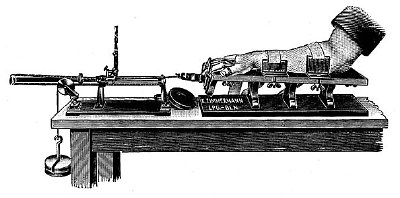
In 1884, ten years after his Leipzig stay, Angelo Mosso began to use a newly invented instrument in his Turin laboratory, the ergograph. Eventually, man's muscular movement could be monitored and, since the subjects were told to bend their muscles deliberately, induced by will instead of electricity. Immediately, Mosso observed significant differences between his results and Kronecker's law of fatigue: "What surprised us most in these trials was the fact that each person has its own fatigue curve." (Mosso 1890, 97) Moreover, the curves reacted most sensibly to internal and external influences of any kind: "Even an indigestion or a bad night's rest, or any sort of excess, suffices to alter the curve in character." (Mosso 1892, 95) In general, and after four years of steady ergographic registration, Mosso could state that his instrument was best and, more than any other, suited to record the "accidental changes" of muscular force during any given period of time. (Mosso 1890, 98) Accident, the worst enemy for experimenters like Claude Bernard or Hugo Kronecker, had thus entered the laboratory and, subsequently, led to studies like Mariano Patrizi's afore mentioned. Patrizi called, for the first time, the new object of physiological study the "everyday".
A Physiologist's Everyday II
Unfortunately, Patrizi's laboratory notebooks have not survived. But his published communications, as well as similar material from the archive of Angelo Mosso's institute, reveal what they most likely would have contained: a sociology of everyday scientific laboratory research. At least, a century later and contrary to their original physiological aim, one might have read Patrizi's notebooks as a sociological study. Well before its theoretical discovery in the work of Edmund Husserl, the everyday had begun to matter in physiology. To endow his faithfully recorded fatigue curves with their actual context, Patrizi had to record his everyday life meticulously, because it was the proper object of study. The monotony, the accidents, and the little occurrences that composed the ordinary life of a physiological experimenter in fin-de-siècle Turin affected his bodily functions and, thus, needed to be included in his experimentation. While Patrizi and his colleagues experimentalized their everyday life to test its effects upon their nerves, future generations of phenomenologists, sociologists, and historians of science began to regard it as the most important key to understand what scientific research was all about. Since Husserl, and his insight that the logic of the sciences can be deciphered in the ordinary practice of scientists, scholars have discovered the everyday. Physiologists had done so before.
Bibliography
- Bernard, Claude. 1957. An introduction to the study of experimental medicine. An unabridged and unaltered republication of the first English translation. New York: Dover Publications
- Husserl, Edmund. 1970. The crisis of European sciences and Transcendental Phenomenology. Evanston: Northwestern University Press
- Kronecker, Hugo. 1871. Über die Ermüdung und Erholung der quergestreiften Muskeln. Arbeiten aus der Physiologischen Anstalt zu Leipzig: 177-265
- Latour, Bruno und Steve Woolgar. 1986. Laboratory Life. The Construction of Scientific Facts. 2nd ed., Princeton: Princeton University Press
- Mosso, Angelo. 1890. Ueber die Gesetze der Ermüdung: Untersuchungen an Muskeln des Menschen. Archiv für Physiologie, Physiologische Abteilung des Archivs für Anatomie und Physiologie: 89-168
- Mosso, Angelo. 1892. Die Ermüdung. Leipzig: Hirzel
- Patrizi, Mariano. 1892. Oscillations quotidiennes du travail musculaire en rapport avec la température du corps. Laboratoire de Physiologie de l'Université de Turin. Travaux de l'année 1891-92. Turin
Related articles
Windgätter, Christof. 2005. "...with mathematic precision". On the Historiography of the Dynamometer.
VL Essays
- Permalink (old)
- http://vlp.uni-regensburg.de/references?id=art12