Open Access
Münsterberg's Photoplays: Instruments and Models in his Laboratories at Freiburg and Harvard (1891-1893)
Henning Schmidgen
Hugo Münsterberg (1863 - 1916) is often quoted as a pioneer of applied psychology. He is also well-known for his philosophy of values, his early theory of the cinema ( The Photoplay, 1916), and the fact that future writer Gertrude Stein (1874-1946), then a student at Radcliffe College, worked in his laboratory in the late 1890s. Less familiar is Münsterberg's role as a creative experimenter and energetic director of psychological laboratories - in Germany and the United States. In this role, Münsterberg contributed significantly to the transition from a cognitive and/or idealist "Physiological Psychology" in the sense of Wilhelm Wundt to the pragmatist and/or functional "Science of Mental Life" as advocated by William James and others.
This present essay argues that this transition was not only grounded in theory and epistemology but corresponded to significant changes in the material culture of Münsterberg's psychological laboratories. In order to reconstruct this materiality, the essay links early photographs of Münsterberg’s laboratories to trade catalogs, scientific publications, short biographies, and other holdings of the Virtual Laboratory. In addition, it connects these images to individual items (instruments, models) preserved in the Collection of Historical Scientific Instruments at Harvard University (go directly to the interactive photograph of the lab in Freiburg and at Harvard [ first and second ]).
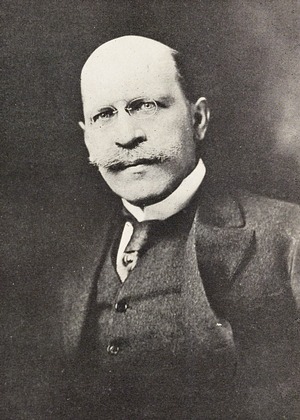
Hugo Münsterberg (1863 - 1916)
Münsterberg's academic career started in 1885 when he completed his philosophy studies with Wundt at Leipzig University with a PhD thesis on the development, application and importance of the theory of natural adaptation. Two years later, he got his MD at Heidelberg University with a thesis on the visual perception of distances ( published in vol. 2 of his Beiträge zur experimentellen Psychologie ). In 1888, he received his Habilitation at Freiburg University with a philosophical study of the problem of voluntary actions. Shortly later, Münsterberg (now a Privatdocent at Freiburg's Philosophy Department) inaugurated a private psychological laboratory. It was located in his apartment and only loosely associated with the university. But along with Wundt's lab in Leipzig (founded in 1879) and the psychological laboratories of Georg Elias Müller in Göttingen (1880) and Götz Martius in Bonn (1888), Münsterberg's lab was one of the first of its kind in the German-speaking world.
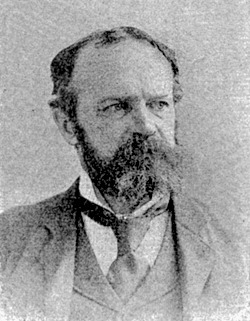
William James (1842-1910)
In early August 1889, Münsterberg attended the first International Congress for Physiological Psychology in Paris. Besides physiological psychology in the Wundtian sense (focused on "normal" adult test persons), this Conference was addressing issues of psychopathology and hypnotism. As a result, Wundt and many of his followers and students refused to attend the meeting. However, it was at the Paris Congress that Münsterberg first met the famous Harvard philosopher and psychologist, William James (1842 - 1910).
James was in the middle of proofreading the two volumes of his textbook "Principles of Psychology", when he left for Paris. In the "Principles", he repeatedly makes reference to and underscores the importance of Münsterberg's contributions to experimental psychology and the study of voluntary action. After their first personal encounter, James and Münsterberg sporadically exchanged letters, starting with a letter by Münsterberg in April 1890 and continuing until the death of James in 1910. At about the same time, James began to send his psychology students to Freiburg for acquiring all the skills needed for practicing the new science of psychology in Münsterberg's lab (rather than Wundt's).
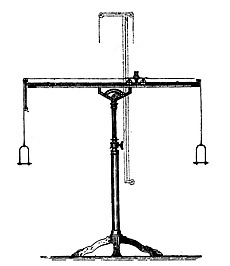
Muskelsinnapparat by Elbs (1895)
In 1892, another early psychological practitioner from the US, William O. Krohn, visited Münsterberg's private lab. In his published description of this research site, Krohn highlighted the fact that it is "distinctively a psychological laboratory" (in contrast, for example, to Johannes von Kries's psycho-physiological laboratory in the same city). With respect to the equipment of Münsterberg's lab, he noted: "The laboratory is provided by the professor with all the current literature. His apparatus is all practical, designed by himself, and constructed by his mechanic, Elbs" ( Krohn, 1891, p. 587).
Born in 1861, Hermann Elbs was a master of precision engineering. After employment in the mechanical workshops of Tesdorpf in Stuttgart, Starke & Kammerer in Vienna and Bamberg in Berlin, Elbs established his own workshop in Freiburg in 1886. He constructed theodolites and other metrological instruments which were required for building and/or improving the railway lines at Elztal and Kandertal, and he provided the University of Freiburg with high precision instruments. For Münsterberg, he devised instruments such as the Augenmassapparat (fig. 1) and the Muskelsinnapparat (fig. 5) that corresponded to Münsterberg's interest in peripheral, i.e. muscular and nervous processes– in contrast to Wundt's focus on psychological functions as such.
In July 1891, Münsterberg sent James his new book on the tasks and methods of psychology ( Über die Aufgaben und Methoden der Psychologie). To the accompanying letter, he attached a photograph, showing himself sitting behind a laboratory table and surrounded by his students and instruments. This photo was originally published in M. Münsterberg (1922) and reprinted in Hale (1980). As Helga Schmitt (1998) has shown, it was not taken 'on site,' i.e. in Münsterberg's home laboratory but at the studio of Freiburg photographer C. Ruf. On the lower margin of the original print Münsterberg wrote: "To Herrn Prof. James, with devoted greetings, from the Laboratory for exper. Psychology, by Hugo Münsterberg." On the lower part of the image he noted his name and the names of his students. They are (from left to right): Donald MacKay, Edmund Delabarre, James Gibson Hume, Carl Alexander, Resa von Schirnhofer, A. Jankovich, then Münsterberg himself, Waldemar Lewy, Hermann Stahr, Johannes Hoops, Abraham Slatopolsky, and Karl Siebert.
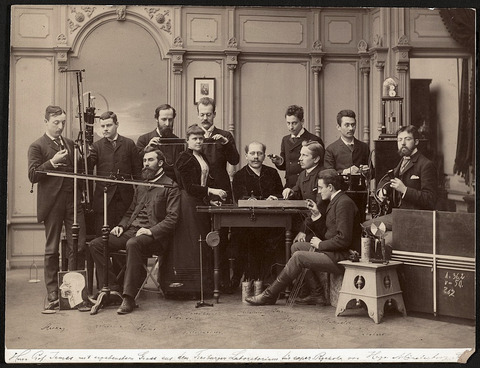
Photograph showing Hugo Münsterberg with his Students, Freiburg 1891
See the original photograph or an interactive version explaining the instruments and persons.
Iconographically, the carefully arranged image is reminiscent of Leonardo Da Vinci's Last Supper – as if anticipating on the final failure of Münsterberg's academic career in the German-speaking context. Instead of food and drinks, psychological instruments are shared between Münsterberg and his eleven disciples – among them Resa von Schirnhofer, a friend of Nietzsche and one of the first female students in Europe. In the role of Doubting Thomas who, in Da Vinci's painting, is placed on the right side of Jesus and raises his finger, the photograph depicts Waldemar Lewy who points a pistol key in a playful manner to Münsterberg's ear. On the left side, three Harvard students group around the Muskelsinnapparat by Elbs that one of them, i.e. Delabarre, was busily using for his PhD on the sensation of movement (published as Über Bewegungsempfindungen in 1891).
The background of the image is also telling. The three windows in Da Vinci's painting are replaced by three emblems of Wundtian psychology: on the right a Hipp chronoscope (the standard for precision time measurements in Wundt's lab), on the left a complication apparatus according to Wundt (for measuring the mental time needed by single representations or ideas), and in the center a framed portrait of Wundt himself [first mise en abyme]. This arrangement can be seen as Münsterberg's tribute to the most important of his academic teachers. At the same time, it should be read as embodying a corresponding to the polemic arguments that Münsterberg, in his writings, put forth against Wundtian psychology: the old, idealist psychology stands in the background, while the new, functionalist psychology performs on stage.
On February 21, 1892, Münsterberg received a letter from James asking whether he would be interested in coming to Harvard as a guest professor and director of the psychology lab for a period of three years. James was quite impressed by Münsterberg's ongoing publications, seeing him as a "real genius" of the new discipline (and a "charming fellow", as he added in a letter to Henry Bowditch in April of the same year). After publication of the "Principles", James had also recognized the need to compete with other emerging psychology labs in the US and in Canada (e. g., Cornell, Toronto). Since he saw himself as unable to direct a laboratory ("I am by nature no experimentalist", he wrote to Münsterberg, on May 15), he turned to the young and brilliant scholar in Freiburg.
On May 13, Münsterberg cabled to James: "Joyfully Accepting the Call." Still in Freiburg, he started to re-organize the Harvard psychology lab, then located in Dane Hall (the first building of the Law School). The main issue was equipping the two rooms of the laboratory with appropriate instruments. Single items were already in possession of James (e. g., a Hipp chronoscope and a set of tuning forks by Koenig), and Münsterberg planned on bringing some of his own instruments from Freiburg. But the large majority of apparatuses and devices was to be newly acquired.
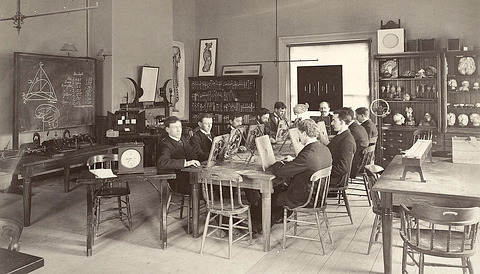
Chain Reaction Test at the Laboratory in Dane Hall
After having retooled the laboratory, Münsterberg started research and teaching at Harvard in the fall of 1892. Assisted by Herbert Nichols, Münsterberg was eager to spread the good news. In January 1893, he presented the new research and teaching facility to the readers of the Harvard Graduate Magazine and proudly declared: "[W]e have the most ample and complete collection of psychological apparatus in the world" ( Münsterberg, 1893a, p. 202).
By the same token, Münsterberg presented a psychological research program that would not limit itself to experimenting with "normal adult men" (as had been the case in Wundtian psychology and Münsterberg's early work in Freiburg) but was meant to encompass comparative observations as well as historical and even literary studies. In striking contrast to the established German tradition of psychological research, Münsterberg even suggested that psychological experiments should be carried out in "children and the sick" as well as in "hypnotic subjects." Furthermore, he argued in favor of experiments in animal psychology – a research practice that was excluded from the Wundtian context in Leipzig.
The difference between the German psychology labs and the new institution at Harvard was not only a matter of size, i.e. the number of psychological instruments. It was also a difference in research programs, as Münsterberg underscored by his contribution to the Harvard University exhibit at the World Fair in Chicago in 1893.
The "World's Columbian Exhibit" was meant to open
its gates to the public in May 1893. Münsterberg did not hesitate. He compiled a
35-page catalog giving a meticulous overview of his
new research and teaching facility. Page after page, he listed an impressive
total of 240 instruments, preparations, models, charts, and other objects in
possession of the Harvard lab – among them unusual instruments such as the
"Hypnoscope" or Mirror hypnotizer after Jules Bernard Luys (see MacDonald 1898,
p. 1167, fig. 39, and a
 color photo
from the Harvard Collection of Historical Scientific Instruments) and a
Rotatory Chair for
the Study of Dizziness (one of the rare topic that James himself had
experimented upon in the early 1880s). Full of pride, Münsterberg explained in
the preface that, although the psychology lab in Dane Hall was established only
recently, its "outfit is, even now, the most nearly complete that is anywhere at
the disposal of students in psychology" (
Münsterberg, 1893b, p. 3).
color photo
from the Harvard Collection of Historical Scientific Instruments) and a
Rotatory Chair for
the Study of Dizziness (one of the rare topic that James himself had
experimented upon in the early 1880s). Full of pride, Münsterberg explained in
the preface that, although the psychology lab in Dane Hall was established only
recently, its "outfit is, even now, the most nearly complete that is anywhere at
the disposal of students in psychology" (
Münsterberg, 1893b, p. 3).
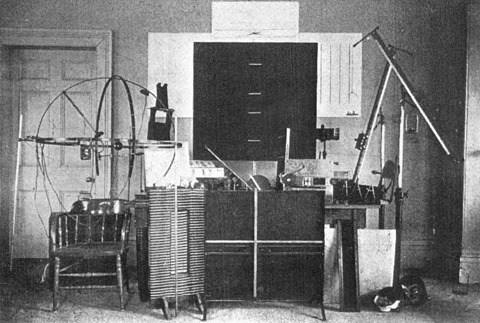
Psychological Laboratory of Harvard University: Perception of Space
In his lengthy enumeration of instruments, Münsterberg inserted a series of eight photographs showing the interior of the Dane Hall lab. The iconography of these images is strikingly different from the Freiburg photograph. Three images show 'psychology in action,' i.e. the interaction of persons and things in the process of psychological experimentation. The remaining five are authentic still lifes depicting artfully arranged instruments for specific areas of psychological research (sight, hearing, perception of space, time measurements of mental acts, etc.).
On some of these photographs, one can detect the presence of Elbs instruments from Freiburg, e.g. the above-mentioned apparatuses for Muskelsinn and Augenmass (see above, on the right side and in the center). New Elbs instruments are also presented, e.g. a device for localizing sound (see above, on the left side, and fig. 8 in Elbs catalog) that was used in combination with the rotatory chair, and a chain reaction apparatus for collective use by up to 10 test subjects and the experimenter (see image on page 4 of this essay and fig. 7 in Elbs catalog). In addition, one can detect instruments from the American context, e.g. the waterfall illusion by Bowditch and Hall (see above, left to the Augenmassapparat , and in addition the corresponding Bowditch-Hall paper, in particular table 1, fig. 1).
Upon closer inspection of the original prints, the photographs offer precise representations of the instruments that Münsterberg had acquired from instrument makers in Europe and the US. One might speak of a non-human lab population that was even more international than the population of humans in his Freiburg lab.
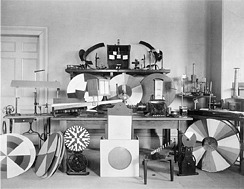
Instruments for Experiments on Sight
Detailed descriptions of some of these instruments are available through the catalogs of the instrument makers that Münsterberg mentions in Appendix B of his catalog. Many of them are part of the holdings of the Virtual Laboratory . In addition, some of these instruments have survived at Harvard and are part of the Collection of Historical Scientific Instruments at the Department of the History of Science.
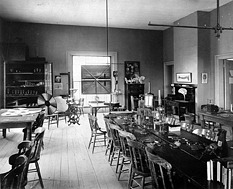
Interior of a Laboratory Room.
The two images above are clickable and give access to high-resolution scans with interactive features for further exploring individual items. Structured links direct the reader to additional images from trade catalogs, detailed descriptions, and short biographies of instrument makers.
As already noted, the photographs of the psychological laboratory at Dane Hall were taken for the World's Columbian Exposition in Chicago. The organizer of The Section on Psychology at this Exposition was Joseph Jastrow (1863-1944). The aim of this Section was, as Jastrow explained, to illustrate the "chief lines of activity in the modern study of psychology" ( Jastrow, 1893, p. 50). According to him, this comprised 1. experimental psychology, 2. comparative psychology, and 3. abnormal psychology. This research agenda implicitly confirmed Münsterberg’s comprehensive vision of psychological science.
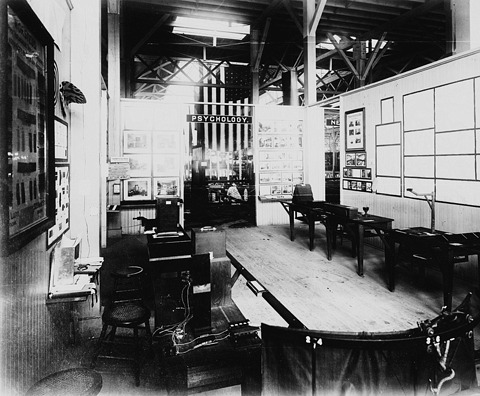
Psychology Show in Chicago 1893, first room with images of the Harvard lab.
Point your mouse to the image to zoom in (contrasts have been partically enhanced to show more detail).
Lodged in the Anthropology building, the Section on Psychology was presented in two rooms: "the one fitted out as a laboratory in operation and the other containing a collection of apparatus used in the experimental study of mental phenomena" ( Jastrow, 1893, p. 50). In the first room, numerous mental tests were presented. In addition, photographs of psychological laboratories in the US and other countries were on display: on the one side Brown, Clark, Columbia, Cornell, Harvard, Illinois, Pennsylvania, Princeton, Toronto, Wellesley, Wisconsin and Yale, on the other Bonn, Geneva, Paris, Prague, Rome, and Tokyo. On one of the surviving photographs of this room, one can recognize six of the photographs taken at Münsterberg’s Harvard lab [second mise en abyme]. Harvard also contributed instruments for display in the second room of the psychology exhibit, among them some made by Elbs in Freiburg.
One of the etchings in Nichols article shows models of the brain and various sense organs (eye, ear). A corresponding photo is not found in Münsterberg's catalog (although it lists these models) but has survived in the archives. This remarkable photography is much larger than the etching published by Nichols. It shows numerous wax and other models of human and animal brains as well as human and animal heads with the brain exposed to the side. It also displays a set of eight wax models showing the phylogenetic development of the brain after Robert Wiedersheim (1848-1923), clastic models of various sense organs (ears and eyes), and – as a kind of striking climax – a large flexible wire model of the human brain. Under the title "Phantom of fibres in the human brain and the spinal mellow," this model was produced by the Swiss optician Adam Ferdinand Buechi in Bern according to the original scheme of the fiber distribution in the brain published by physiologist Christoph Aeby in 1883.
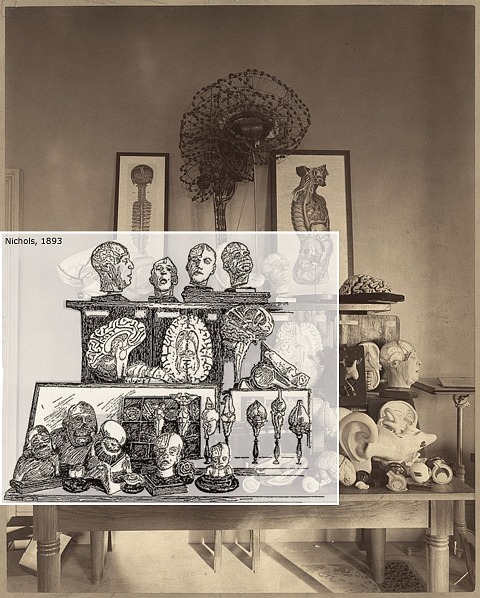
Display of Wax Models, 1892 (Image: Harvard University Archive); overlay: Nichols, 1893
Point your mouse to the image to fade out the layer.
In his short description of the dynamic device, Buechi wrote: "The phantom shows the natural form of the brain and a portion of the spinal marrow nearly six times enlarged. It is intended to exhibit the extremely complicated and difficultly traceable structure of the central nervous system according to the scientific views of the present day. The ganglia are represented by pieces of cork, their connecting fibres by wires and both are according to their relation arranged to groups by different coloring. Every body may in harmony with its wonts insert easily other currents or change the existing."
Ironically, it is this unpublished photograph that, in retrospect, perfectly illustrates Münsterberg's turn from the idealist Wundtian psychology to James's pragmatic and evolutionary science of mental life. Offering a comparative and at the same time hierarchically ordered view of the development of animal and human brains, it programmatically shows the comprehensive scope of experimental psychological science that Münsterberg was to establish when returning to Harvard on a permanent basis in 1897.
After the World Fair in Chicago, Münsterberg's assistant Nichols published another description of the psychology lab in Dane Hall, this time for one of the first issues McClure's Magazine , a popular illustrated monthly journal. As Nichols explains in a footnote to his article, his piece includes images from Münsterberg's catalog: "The illustrations of this article are from photographs, specially taken for the Harvard University Exhibit at the World's fair" ( Nichols, 1893, p. 399). More precisely, two of the photographs are reproduced as such, whereas two others are printed as etchings. In contrast to Münsterberg, Nichols does not focus on describing the still life of instruments. What he offers are descriptions of 'psychology in action'.
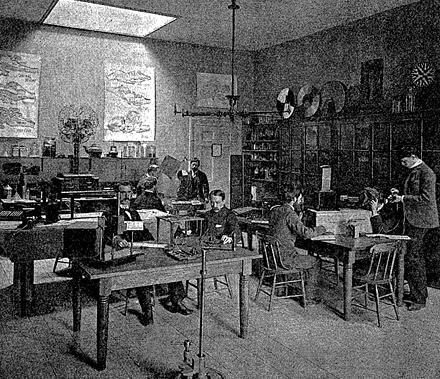
Studying the effects of sound and attention on colors ( Nichols, 1893, p. 400)
Point your mouse to the image to see a high-resolution scan of the same image from the Harvard University Archives.
As Nichols explains the second image of Münsterberg's catalog (see above) depicts two experiments that aim at discovering "the laws by which the simplest sensations modify each other under the simplest conditions" ( Nichols, 1893, p. 400).
The right hand group investigates the effect of sound on the perception of color: the test subject (covered with a cloth) is looking onto a small screen lit from behind by the light beam of a lantern. At the same time, he is subjected to the sound of a tuning fork (handheld by the student standing nearby). The perception of different colors is then tested with respect to the varying brightness and size of color projection and the presence or absence of tuning fork sounds.
Following the same scheme, the rear group shows an experiment with a color mixer that allows darkening or brightening the color presented to the test subject (sitting in front of the table). Nichols continues: "The persons operated on do not know what change is made or whether any will be made or not. They first look at the disk for ten seconds, taking good note of its color. Next, the operator changes the shade (or not) as he sees fit. Then for another ten seconds the subject judges the shade of color, but this time performs meanwhile a sum in addition as the operator calls to him simple numbers" ( Nichols, 1893, p. 401).
Summary
The photographs of Münsterberg's labs in Freiburg and at Harvard are important sources for writing the history of the "Experimentalization of Life." They illustrate a decisive shift in psychological research practices: from a cognitive and/or idealist "Physiological Psychology" in the sense of Wundt to the pragmatist and/or functional "Science of Mental Life" as advocated by James and others. Münsterberg skillfully used these photographs as a powerful means for depicting his laboratories in various contexts and for different purposes – from his private correspondence to the public at large. Given their multiple uses in catalogs, exhibition rooms, and popular articles one could say that they have "a live of their own" – similar to the scientific instruments themselves.
| Münsterberg 1893 | World Fair 1893 | Nichols 1893 | Harvard Archives |

|

|

|
|

|

|

|
|

|

|
|
|

|
|||

|
|
||

|
|
||

|

|

|
|

|

|
||

|

|
||

|
Acknowledgment
This essay would not have been possible without the invaluable help of Rand B. Evans and the Virtual Laboratory staff, in particular Kaja Kruse and Michael Behr. Rand and Kaja were crucial in identifying many of the instruments on the laboratory photographs that are presented and discussed here, while Michael provided the technical support for establishing smart links between these photographs and the other holdings of the VL. Thanks also to Julia Kursell, Matthias M. Weber and Wolfgang Burgmair for contributing to decipher the signatures on Münsterberg’s Freiburg photo. Thanks to Urs Schoepflin for helping in ordering and acquiring digitized versions of the photographs. Eventually, I gratefully acknowledge permission by the Harvard University Archives and the Peabody Museum of Archaeology & Ethnology for publishing their material on this web site.
References
- Delabarre, Edmund Burke. 1891. Über Bewegungsempfindungen. Inaugural-Dissertation zu Erlangung der Doktorwürde vorgelegt der hohen philosophischen Fakultät der Albert-Ludwigs-Universität zu Freiburg i. B. Freiburg in Baden: Epstein
- Hale Jr., Matthew. 1980. Human Science and Social Order. Hugo Münsterberg and the Origins of Applied Psychology, Philadelphia: Temple University Press.
- Greene, Christopher D. 2002. Toronto's "other" Original APA Member: James Gibson Hume, Canadian Psychology 43/1: 35-45.
- James, William. 1890. The Principles of Psychology. New York
- James, William. 1999. The Correspondence of William James, vol. 7: 1890-1894, ed. by Ignas K. Srupskelis and Elizabeth M. Berkeley, Charlottsville and London: University Press of Virginia.
- Jastrow, Joseph. 1893. The Section of Psychology. In: Official Catalogue: World's Columbian Exposition, Part VII, edited by Willard A. Smith, 50-60. Chicago: W. B. Conkey
- Krohn, William O. 1891. Facilities in Experimental Psychology at the various German Universities. American Journal of Psychology 4: 585-594
- MacDonald, Arthur. 1898. Chapter V: Psycho-physical and Anthropometrical Instruments of Precision in the Laboratory of the Bureau of Education. In: Experimental Study of Children, 1141-1204
- Münsterberg, Hugo. 1885. Die Lehre von der natürlichen Anpassung in ihrer Entwickelung, Anwendung und Bedeutung. Inaugural-Dissertation zur Erlangung der Doctorwürde bei der Philosophischen Fakultät Leipzig. Leipzig: Metzger und Wittig
- Münsterberg, Hugo. 1888. Die Willenshandlung. Habilitationsschrift. Freiburg i. B.: C. A. Wagner
- Münsterberg, Hugo. 1889. Augenmass. In: Beiträge zur experimentellen Psychologie, Heft 2, edited by Münsterberg, Hugo, 125-181. Freiburg i.B.: Mohr
- Münsterberg, Hugo. 1891. Ueber Aufgaben und Methoden der Psychologie. Leipzig: Verlag von Ambr. Abel
- Münsterberg, Hugo. 1893a. The New Psychology, and Harvard's Equipment for Teaching it. Harvard Graduate's Magazine 1: 201-209
- Münsterberg, Hugo. 1893b. Psychological Laboratory of Harvard University. Cambridge, Mass.: University Press of Cambridge, Mass.
- Münsterberg, Hugo. 1916. The Photoplay. A psychological study. New York & London: Appleton
- Münsterberg, Hugo. 1908. Philosophie der Werte: Grundzüge einer Weltanschauung. Leipzig: Barth
- Münsterberg, Margaret. 1922. Hugo Münsterberg. His Life and Work. New York, London: D. Appleton and Company
- Nichols, Herbert. 1893. The Psychological Laboratory at Harvard. McClure's Magazine: 399-409
- Schmitt, Helga. 1988. Die Entwicklung der Psychologie an der Universität Freiburg von 1880 bis 1920. Unpublished Master thesis, Psychological Institute, Freiburg.
VL Essays
- Permalink (old)
- http://vlp.uni-regensburg.de/references?id=art71