Open Access
Armadillos and the issue of specific polyembryony
Susana V. García
The armadillos are small mammals of South and Central America, known for having a bony armor shell. The nine-banded armadillo ( Dasypus novemcinctus ) is the most widespread of this family that expanded to Texas in the 1850s. This species and the "mulita" ( Dasypus hybridus ) from Argentine and Paraguay are today the only known mammals that exhibit "specific polyembryony"; i.e. a process in which the fertilized ovum regularly gives rise to more than a single embryo.
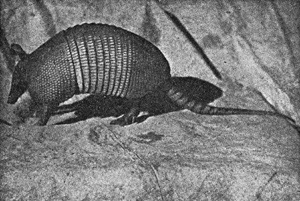
Photograph of a living armadillo showing the complete armor and usual resting attitude.
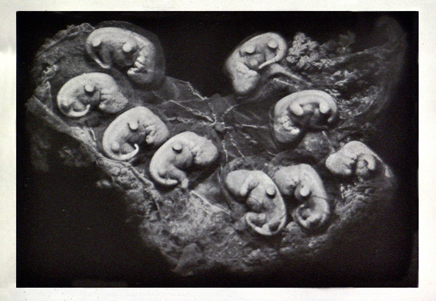
In the late nineteenth century, some naturalists in Europe observed one or two pregnant uteruses of preserved nine-banded armadillo and found a curious phenomenon: the four foetuses were surrounded of a common chorion, a fact that contrasted to the known fact that every single mammalian foetus possessed its own chorion.
In South America there was a popular belief that in a certain species of armadillo all of the offspring from one mother was either male or female, a curious phenomenon mentioned by European travellers and naturalists. In the 1880s, the German zoologist Hermann von Ihering tested this belief in Brazil, by observing two pregnant females of mulita obtained in Paraguay. Each female contained eight foetuses and they were in fact all males. Von Ihering surmised that they originated from a single egg. In 1901, a different hypothesis was proposed by the Polish researcher Aleksander Rosner, on the basis of a histological examination of the ovaries of one nine-banded armadillo sent by Ihering from Brazil. Rosner found polyovular follicles in this specimen; he proposed that the four foetuses were formed of four ova discharged together and that the common chorion derived from the union of the contiguous walls of the embryos. Later observations showed that Rosner's material was pathological or quite exceptional.
In the 1900s the "polyembryony" became a crucial issue. This phenomenon was observed in certain parasites and other invertebrates, and by experimental intervention, in echinoderms and fishes. It was linked with the problem of the determination of sex and some authors reopened the case of armadillos, pointing out that, in all probability, the multiple twins of armadillo proceeded from a single egg. In 1909 Miguel Fernández, professor at La Plata University (Argentine), provided evidence for this hypothesis in the case of mulita ( Fernandez 1909). At the same time, Horatio H. Newman and J. Thomas Patterson, zoologists from the University of Texas, published on the nine-banded armadillo of Texas ( Newman and Patterson 1910).
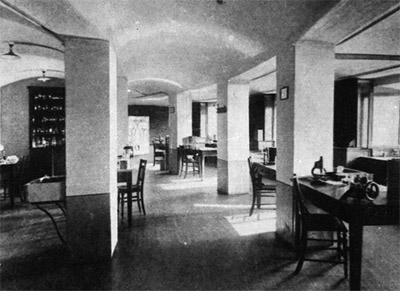
The Zoological Laboratory of La Plata University (1927).
These papers were based on systematic research on the embryological development of these animals. At each development stage, a different organism was killed and dissected for examination. The growing of the embryonic structures could not be directly observed, it was only inferred after the fact that growth had taken place, deducing what was happening among the sequential slices of preserved moments (Hopwood 1999). This type of investigation required a great number of pregnant females in order to fix the earliest stages of the development and obtain reliable evidence. This turned out to be difficult since mulita and armadillo were non-domesticated mammals and species that reproduced once a year.
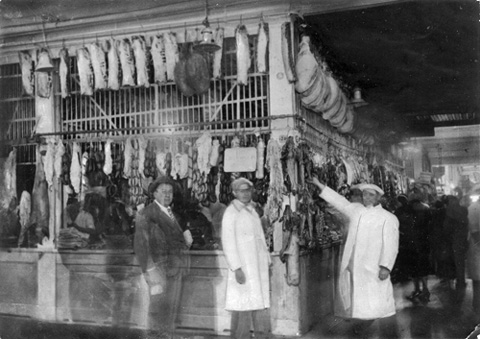
Meat market in Buenos Aires
In La Plata, Fernández began to gather different species of armadillos in 1906, after finishing his studies in Europe. In those years, the mulita was a highly priced meal and thousands of them were sent to urban markets. Fernández had several problems breeding mulitas in captivity, but he could obtain relatively easily living specimens in delicatessen stores. He demonstrated that all sets of embryos were the product of the early division of a single embryo derived from a single fertilized egg (
Fernandez 1909). Fernández succeeded in securing two well-preserved very young embryonic vesicles, in which the demarcation of the several embryonic primordial had not yet manifested difficult because they occured only at a particular moment in the year. In this case, the gastronomic importance of mulitas and their facilities of transportation from the field to the city and the lab were local circumstances that made it possible to coordinate 'research and phenomenon timing'.
In fact, Newmann and Patterson had failed to find the earliest stages. In a paper published in 1910, they mentioned the problem of the time of transportation of animals from the field to the lab in Austin:
During the breeding season hunters employed to collect material for us covered a wide range of territory in south-central Texas. These men were frequently obliged to haul the living animals through rough country for distances of fifty miles or more in order to reach an express office whence they could be shipped to our laboratories. As a rule a number of days elapsed between the capture of the annuals and their arrival in Austin. This delay would serve in part to explain our ill success in securing the earliest embryonic stages. In order to obtain a complete series we believe it will be necessary either to breed the animals in captivity or to accompany the hunters on their expeditions so as to lose no time in examining freshly fertilize females. Although we fully expect to secure the earliest stages in the course of time it seems inadvisable for us to postpone the publication of the results thus far obtained... ( Newman and Patterson 1910, p. 363-364).
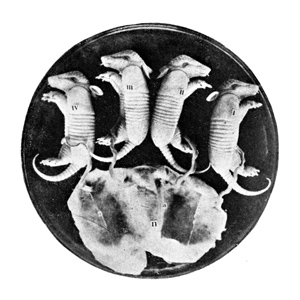
A vesticle of the nine-banded armadillo cut open along the mid-ventral line.
In the following years, they changed their strategy for obtaining specimens for study. There were several problems for the scientific stabilization of these animals in the laboratory because of the change of armadillo’s habits and a poor survival-rate in captivity. Newman recognised that armadillo breeding was not at present practicable and therefore, he had to go to the field with local hunters. At certain localities of Texas, Newman found a flourishing industry in which many thousands of armadillos were slaughtered annually for their armour. Thanks to the hunters and dealers of "armadillo basket", he had no difficulty in obtaining hundreds of pregnant females ( Newman 1913).
Newmann and Patterson published a number of papers dealing with matters of development, cytology, sex-determination and heredity in the Texas armadillo and also formulated theories about the causes of twinning, a topic of ongoing debate. After the confirmation of "specific polyembryony", the armadillo served as a powerful natural tool for investigating certain basic problems of heredity, such as the analysis of "prederminative" versus "epigenetic" factors or the limits of heredity control. However, during that time, the difficulty of raising armadillos in the laboratory meant that these animals could not become significant tools in laboratory studies. Since then the armadillos have become important as research organism in the biomedical research as they are natural hosts of several protozoal and bacterial pathogens, such as leprosy.
Bibliography
- Fernandez, Miguel. 1909. Beiträge zur Embryologie der Gürteltiere. Morphologisches Jahrbuch 39: 302-333
- Fernandez, Miguel. 1915. Die Entwicklung der Mulita. La Embriologia de la Mulita (Tatusia hybrida Desm.). La Plata; Leipzig: Museo de La Plata; Karl W. Hiersemann
- Hopwood, Nick. 1999, "Giving Body" to Embryos. Modelling, Mechanism, and Microtome in late Nineteenth-Century Anatomy. Isis 90: 462-496
- Newman, H. H. and Patterson, J. Thomas. 1910. The Development of the Nine-banded Armadillo from the Primitive Streak Stage To Birth; With Especial Reference to the Question of Specific Polyembryony. Journal of Morphology 21: 359-423
- Newman, H. H. 1913. The Natural History of the Nine-banded Armadillo of Texas. The American Naturalist 47: 513-539
VL Essays
- Permalink (old)
- http://vlp.uni-regensburg.de/references?id=art72