Open Access
Apollo's Laboratory
Sven Dierig
|
The human and godly forms of antiquity, surrounded
by undying magic; the stories and legends of the Mediterranean peoples,
in which almost all beauty and goodness are rooted; the mental exchanges
of classical society, indispensable to the natural sciences and from which
favored men have risen to almost unequaled heights: these are the thing
whose penetration of young people's minds offers the surest cure in the
struggle against neobarbarism, whose iron arm now holds us loosely, but
whose grip will almost certainly tighten. May Hellenism keep Americanism
far from our borders!
Emil Du Bois-Reymond 1877 |
In early 1841, Berlin physiologist and anatomist Johannes Müller gave his twenty-three-year-old medical student Emil Du Bois-Reymond a research report by Italian physicist Carlo Matteuci, a paper that had received special attention at the Paris Academy of Sciences a year ago. Du Bois-Reymond was to repeat, verify, and extend Matteuci's experiments on the electrical properties of frog muscles as described in Matteuci's Essai sur les Phénomènes électriques des Animaux . After seven years of research, the result appeared in 1848-49: Du Bois-Reymond's Untersuchungen über Thierische Elektricität [see also: Du Bois Reymond's Laboratory Notebooks].
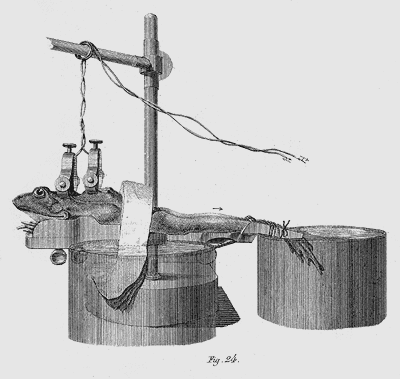
Du Bois-Reymond: Frog Experiment (1848)
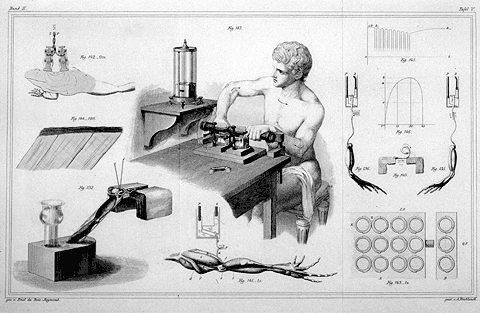
This comprehensive text of several hundred pages described the experiments conducted by Du Bois-Reymond in minute detail. As an appendix, it offered an extensive series of plates illustrating the most important experimental set-ups, instruments, and frog preparations.
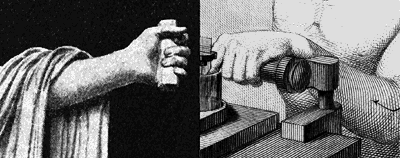
Table five (vol. 2, part 2) shows a young man seated before a galvanometer at a simple table, busily adjusting his experimental set-up. The young investigator has the idealized bodily form of classical sculpture. Since Du Bois-Reymond never revealed anything about this illustration, either in Thierische Elektricität or anywhere else, one is left with a simple question: what message is conveyed to the reader through this illustration of a graceful, classical experimenter that is not written into the main text? Because Du Bois-Reymond evidently intended the reader to interpret this image, I will attempt to do so in this essay. To support my argument, I will use a classical reference popular in Du Bois-Reymond's boyhood: the Greek image of the ever youthful Apollo.
;)
My interpretation of this "classical" experimenter draws upon the following Apollo motifs: Apollo as heroic dragon-slayer, Apollo as ideal athlete, and Apollo as the god of harmonic order. To avoid misinterpretations, I do not propose that Du Bois-Reymond's representation of a young experimenter is necessarily an illustration of Apollo. Still, the figure of Apollo can serve as a point of departure. Relying on the Apollo motif, I will argue that Du Bois-Reymond represented himself in Thierische Elektricität in the pose of the young male hero, as an athlete who worked out with laboratory instruments and as a form-giving artist who combined classical aesthetics and the contemporary notion of Bildung with experimental physiology.
The Heroic Experimenter
In the early 1840s, Du Bois-Reymond belonged to a group of Berlin students for whom experimental physics was the unshakeable model for the investigation of life. "Sworn to demonstrate the truth that no forces operate in living organisms except physico-chemical ones," Emil Du Bois-Reymond, Ernst Brücke and Hermann v. Helmholtz saw themselves as the avant-garde of experimental physiology and felt obligated to defend it against the 'establishment': the faculty of the Berlin medical school, whom they perceived as hostile to experimentation. The introduction to Thierische Elektricität contains a heated, highly polemical attack on the idea of a Lebenskraft (Life-force). Vitalistic outlooks, storms Du Bois-Reymond, are nothing but "a tissue woven of the most arbitrary claims, ... a murky empire of speculation." The concept of Lebenskraft is an expression about which "reason has been put to sleep in the soft armchair of obscurity." Against this "specter," which must "finally be burned out," the only possible aids were the clear language of physics and the experimental physiology conducted with instruments modeled after those in physics laboratories.
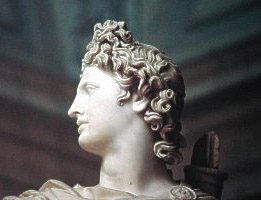
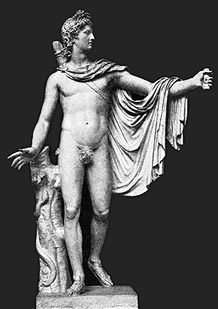 Phoebus and Lyceus, Apollo's
epithets, define him as pure, a bringer of light, the enemy of all darkness
and the defender against evil.
The whole enterprising spirit of young Du Bois-Reymond was directed against the "dark,
uncertain" nature of
Lebenskraft
, and Apollo offered the best classical
model for creating an image of a lone male warrior. "The highest concept of
ideal, manly youth takes form in the Apollo Belvedere," reads
Johann Joachim Winckelmann's
Geschichte der Kunst des
Altertums
. Apollo is "the most beautiful of the gods," for his form
suggests "a youth born to nobility and great intentions." The
Winckelmann-enthusiast Herder sounds much the same: Apollo is "the highest
symbol of all the young heroes of mankind," and his form is "a heroic thought
rendered visible." Invoking the Apollo Belvedere, who is armed with a bow and
arrow and in his youth slew the dragon Python to free the Delphic oracle and its
knowledge of the future, Du Bois-Reymond presents himself in the introduction to
Thierische Elektricität
as an experimenter armed with laboratory
instruments with which he will attack the Python (vitalism) that is darkening
the future of science. Interpreted as an experimenting Apollo, Du Bois-Reymond's
illustration of the classical youth becomes a pictorial introduction to
Thierische Elektricität
, the self-confidence of organic physics conveyed
as an image.
Phoebus and Lyceus, Apollo's
epithets, define him as pure, a bringer of light, the enemy of all darkness
and the defender against evil.
The whole enterprising spirit of young Du Bois-Reymond was directed against the "dark,
uncertain" nature of
Lebenskraft
, and Apollo offered the best classical
model for creating an image of a lone male warrior. "The highest concept of
ideal, manly youth takes form in the Apollo Belvedere," reads
Johann Joachim Winckelmann's
Geschichte der Kunst des
Altertums
. Apollo is "the most beautiful of the gods," for his form
suggests "a youth born to nobility and great intentions." The
Winckelmann-enthusiast Herder sounds much the same: Apollo is "the highest
symbol of all the young heroes of mankind," and his form is "a heroic thought
rendered visible." Invoking the Apollo Belvedere, who is armed with a bow and
arrow and in his youth slew the dragon Python to free the Delphic oracle and its
knowledge of the future, Du Bois-Reymond presents himself in the introduction to
Thierische Elektricität
as an experimenter armed with laboratory
instruments with which he will attack the Python (vitalism) that is darkening
the future of science. Interpreted as an experimenting Apollo, Du Bois-Reymond's
illustration of the classical youth becomes a pictorial introduction to
Thierische Elektricität
, the self-confidence of organic physics conveyed
as an image.
The Athletic Experimenter
At the time the copper engravings for the second volume of Thierische Elektricität were produced, Du Bois-Reymond was teaching anatomy at the Prussian Academy of Arts. Like the anatomical drawings of art students, Du Bois-Reymond's representation of a youthful experimenter was based on a model of a particular kind. Du Bois-Reymond's brother, David-Paul Gustave, posed for the photograph on which the illustration of the young experimenter was based.
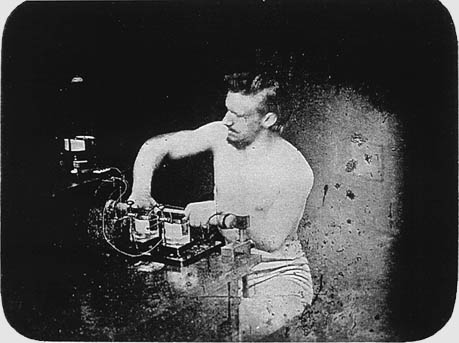
This self-experiment that Du Bois-Reymond conducted with dozens of subjects in his laboratory aimed to show that the subject's voluntarily contracted arm muscles created electrical current on his body surface strong enough to deflect the magnetic needle of a galvanometer. The current generated during the muscular contraction was conducted via the subject's index finger, which was immersed in a chamber of salt solution electrically connected to the galvanometer by a metal electrode and copper wire. To promote the conduction of current, the subject's upper body was unclothed. To create a perceptible deflection of the galvanometer's magnetic needle, the subject had to have especially good control of his body. Du Bois-Reymond described the decisive moment in a letter to Alexander von Humboldt:
Just at this instant, I tighten all the muscles of my arm so that I produce an equilibrium between the flexors and extensors of all the joints in the limb, somewhat as one does in gymnastics schools, gingerly testing one's muscular development. ... All other things being equal, the size of the deviation depends largely on the level of development and exercise of the muscles. I have pretty strong arms; until now, of all the many scholars who have undergone this experiment in my laboratory, I have found none with whom it has succeeded better than with myself. There are also people who cannot produce a perceptible deviation of my galvanometer needle, but in these cases, I am not convinced that the muscles achieve the necessary degree of contraction.
Of course, the figure of Apollo was on hand to help represent the nudity and athleticism necessary for this self-experiment. In classical mythology, Apollo was not just an excellent archer but a talented gymnast ( gymnos means "nude") heralded as the first winner of the Olympic games.
Self-Perfection
In neo-classicism, the fully developed body--naked and godlike, for Winckelmann achieving its highest expression in the Apollo Belvedere--served as the aesthetic norm. One of the forms of Bildung through which less than ideal bodies could approach this unreachable norm was gymnastics. The gym, which in 1840s Berlin was re-establishing itself after a long period of prohibition, was well-known territory to young Du Bois-Reymond. While performing the research for Thierische Elektricität , he served as a "model gymnast" at the Eiselnchen Institute, organizing teams for many different age groups and working out himself on the high bar and parallel bars. The "drive for perfection" that ruled in the gym was also one of the key qualities for successful experimentation. Without "practice in experimentation," one could never solve anything at the experimental table. In a letter to Carl Ludwig, Du Bois-Reymond wrote in 1848:
I succeeded very quickly in translating the pain that would have been caused by scalding a frog's leg into an electromagnetic movement. With persistent practice and perfection of the experimental technique , I don't see any reason why I shouldn't also be able to translate the current along the optic nerve--of a pike, for instance--that is so critical for vision, into its magnetic equivalent
The notion of "practice" in a physical sense merges easily with the humanistic goal of Bildung . "To perfect oneself through practice," "self-perfection through practice" is a quality of higher organisms, but particularly of human beings, declared Du Bois-Reymond in his lecture, "Über die Übung." From gymnastics to experimentation, one achieved Bildung only through the form-giving power of practice, through the "frequent repetition of a complex bodily activity with the assistance of the mind." Through "frequently repeated experiments and considerable practice" at the experimental table, as Helmholtz indicated, one could finally achieve that simultaneous, implicit knowledge of hand and head.
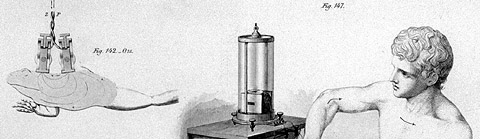
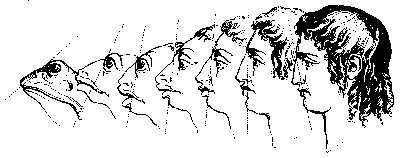
In the context of an increasingly physical Bildung Du Bois-Reymond's drawing of a Greek boy becomes a representation of the fully practiced experimenter. Like a gymnast on the bars, through "practice and perfection," Du Bois-Reymond slowly converts himself in the lab from a crude, organic mass - the untrained nerves and muscles of his own experimenting body - into the ideal form of Apollo. The gaze of the Greek boy in Thierische Elektricität , which is directed toward a frog, suggests Du Bois-Reymond's grandfather's drawings of Lavater's physiognomic stages. Self-perfection through experimental practice shaped the experimenter, who step by step converted himself from an ugly, uneducated frog into an ideal, fully educated Apollo.
Bibliography
Primary Literature
- Du Bois-Reymond, Emil. 1848. Untersuchungen über thierische Elektricität, Erster Band. Berlin: Georg Reimer
- Du Bois-Reymond, Emil. 1849. Untersuchungen über thierische Elektricität, Zweiter Band, Erste Abtheilung. Berlin: Georg Reimer
- Du Bois-Reymond, Emil. 1860. Untersuchungen über thierische Elektricität, Zweiter Band, Zweite Abtheilung (Erste Lieferung). Berlin: Georg Reimer
- Du Bois-Reymond, Emil. 1884. Untersuchungen über thierische Elektricität, Zweiter Band, Zweite Abtheilung (Zweite Lieferung). Berlin: Georg Reimer
- Du Bois-Reymond's Laboratory Notebooks
- Camphausen, Christoph von. 1981. Elektrophysiologische und physiologische Modellvorstellungen bei Emil du Bois-Reymond. Naturwissen und Erkenntnis im 19. Jahrhundert: Emil du Bois-Reymond. edited by Gunter Mann, 79-104. Hildesheim: Gerstenberg.
- Dierig, Sven. 2004. Die Kunst des Versuchens - Emil Du Bois-Reymonds 'Untersuchungen über thierische Elektricität'. In: Kultur im Experiment, edited by Henning Schmidgen, Peter Geimer and Sven Dierig, 123-146, 384-391. Berlin: Kadmos
- Finkelstein, Gabriel Ward. 1996. Emil Du Bois-Reymond. The Making of a Liberal German Scientist (1818-1851). Diss. phil. Princeton University
- Lenoir, Timothy. 1986. Models and Instruments in the Development of Electrophysiology. Historical Studies in the Physical and Biological Sciences 17: 1-54
- Lenoir, Timothy. 1992. Laboratories, Medicine and Public Life in Germany 1830-1849: Ideological Roots of the Institutional Revolution. In: The Laboratory Revolution in Medicine, eds. Andrew Cunningham and Perry Williams, 14-71. Cambridge University Press
- Lenoir, Timothy. 1997. Social Interests and the Organic Physics of 1847. In: Instituting Science. The Cultural Production of Scientific Disciplines, edited by Timothy Lenoir, 75-95. Stanford University Press
- Lohff, Brigitte. 1981. Emil du Bois-Reymonds Theorie des Experiments. In: Naturwissen und Erkenntnis im 19. Jahrhundert: Emil du Bois-Reymond, edited by Gunter Mann, 117-128. Hildesheim: Gerstenberg
VL Essays
- Permalink (old)
- http://vlp.uni-regensburg.de/references?id=art8