The Virtual Laboratory - Resources on Experimental Life Sciences
  • Upload
Log in Sign up

Horse

VL Images

English description

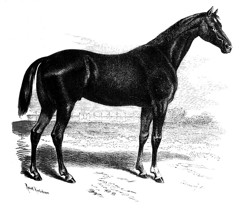
* Most part of Central and Northern Europe, Central Asia, and the whole Africa should be seen as the original distribution area of the horse. In Europe, wild horses seem to have died out not that long ago; in Asia and Africa, they roam up to the present day. Horses are lively, spirited, quick, and smart animals. There is something charming and cocky about their movements. The usual pace of those living in the wild is a rather rapid trot; they run at a relatively light gallop. Their reproduction rate is low. Mares foal after a long gestation period, giving birth to single young horses after wide intervals. Different species of plants and grains constitute the habitual forage. They definitely prosper better in dry than in humid, marshy areas, although they tolerate grass of poor quality better than other domestic animals.

Related records

Related VL Sites

Psychological Laboratory, Harvard University. Cambridge (MA).

Physiological Institute, University of Turin. Turin (Italy) .

Physiological Institute, University of Leipzig. Leipzig (Germany).

Physiological Institute, University of Groningen. Groningen (Netherlands).

Institute of Physiology, University of Copenhagen. Copenhagen (Denmark).

Institute of Physiology, University of Louvain. Leuven (Belgium).

Institute of Physiology, University of Marburg. Marburg (Germany).

Grand Ducal Saxon Veterinary Institute. Jena (Germany).

Technical instruments

Inscriptor for the walk of the horse.

Apparatus to show the position of the nodes on the opposite sides of a horse-hair vibrating longitudinally.

Electromotor with installed eqipiment to reduce the number of revolutions. 1/120 horsepower. 150 revolutions/hour.

Blood pressure apparatus for horses according to Dr. Kiesel.

Further Reading

Abderhalden, Emil. Berthold Oppler. 1907. Über das Verhalten einiger Polypeptide gegen Blut-Plasma und -Serum vom Pferde. In: Zeitschrift für Physiologische Chemie 53: 294-307. Journal Article

Dupuy. 1822. Über die Zerreißung des Magens beim Pferde: Aus Magendie's Journal de Physiologie, T. I, p. 333 ff.. In: Deutsches Archiv für die Physiologie 7: 473-477. Journal Article

Düpüy. 1818. Versuche über die Wegnahme des ersten Halsknotens des Gangliennerven bei Pferden: Aus Leroux's Journ. de médec., T. 37, 1816, p. 340-350. In: Deutsches Archiv für die Physiologie 4: 105-108. Journal Article

John, J. F.. 1816. Chemische Untersuchungen des Harns eines diabetischen Pferdes. In: Deutsches Archiv für die Physiologie 2: 380-387. Journal Article

Gurtl. 1820. Beschreibung und Abbildung einer spiralförmig gewundenen Klappe an der Cardia des Pferdes. In: Deutsches Archiv für die Physiologie 6: 539-541. Journal Article

Search for related VL records.

VL Objects

Permalink (old)
http://vlp.uni-regensburg.de/references?id=obj3

Export

  • Dublin Core
  • JSON

Language:

© Universitätsbibliothek Regensburg | Imprint | Privacy policy | Contact | Icons by Font Awesome and Icons8 | Powered by Invenio & Zenodo